
Essex VINELink Release Coverage
VINELink is the public web entry for Virginia custody information and event notifications, but there is no single registration that follows every system. For a recent Essex County arrest, the likely local custodian is Middle Peninsula Regional Security Center in Saluda. That record belongs in Virginia Jail VINE. A state-responsible person in a VADOC institution, in certain local jail beds under VADOC authority, or moving toward state release belongs in VADOC VINE.
The distinction is about legal custody, not simply where a person sleeps. Someone can be physically inside a regional jail while VADOC controls the state sentence. A jail notice can also mark a transfer into VADOC rather than freedom. Before searching, identify the arresting case, likely facility, and whether the sentence is local or state-responsible. That choice prevents a false no-result conclusion.
| Virginia channel | Who it covers | What registration means |
|---|---|---|
| Virginia Jail VINE | Participating local and regional jails, including the MPRSC path for Essex | Tracks reported jail events; registration is generally open |
| VADOC VINE | People in the care of Virginia Department of Corrections | Separate DOC workflow; VADOC limits registration to crime victims |
| Registry registration | Virginia sex-offender registry information for qualifying registrants | Third, separate service; it is not a jail or prison release record |
| Federal systems | BOP, ICE, or USMS custody | Not covered by these Virginia VINE registrations |
Search One Essex Inmate on VINELink
Start with a specific person, not a broad recent-release list. Choose Virginia, then select the relevant jail or VADOC dataset. The jail workflow accepts a name or offender or booking number. Compare all identifiers the service actually provides because names may be shared, shortened, or entered with a middle name. The research did not verify a live released Virginia result, so no exact post-release label should be assumed.
- Open VINELink and choose Virginia from the jurisdiction menu.
- Select the Virginia Jail VINE or VADOC custody dataset that matches the person's legal custodian.
- Search by full name or the identifier offered for that dataset.
- Compare the returned identifiers and facility information before opening the matched record.
- Read the current status exactly as displayed and note when the information was checked.
- If the match is uncertain, call MPRSC or use the VADOC locator before registering.
For MPRSC, compare the VINELink match with the facility's current inmate listing. That public roster shows current people, not released people. A name missing there may reflect community release, transfer, a data change, or a name mismatch. VINELink adds an event source, but direct facility confirmation or an existing release sheet remains stronger proof of what happened.
The captured service screen comes from the official VINELink Virginia selection and search route.
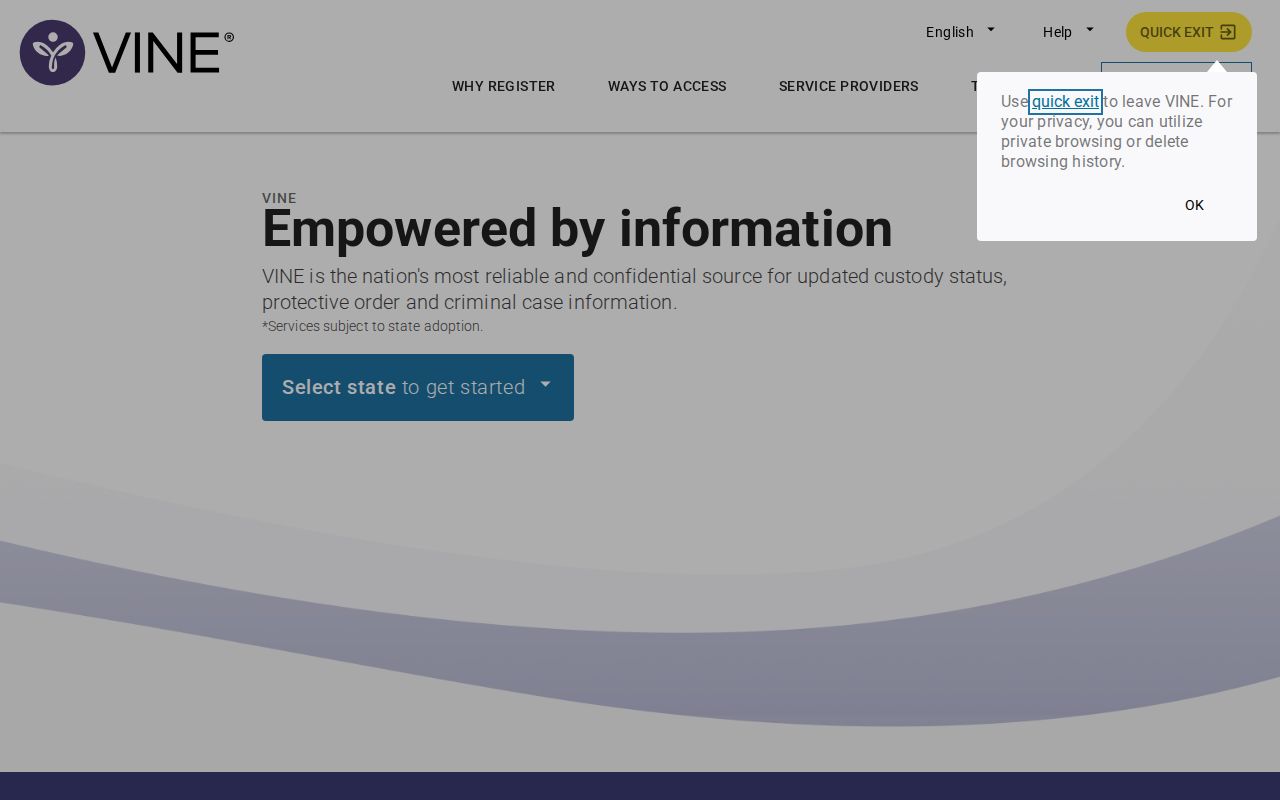
The image helps locate the Virginia workflow; it does not document an exact released-result label for an Essex County person.
Essex VINELink Record Details
The details shown depend on the feeding agency and the live record. Review only fields actually displayed. For a jail search, the useful questions are whether the identity matches, which facility supplied the information, what current custody state appears, and which notifications are available. Do not add a release date or reason when the record does not show one.
| Record element | How to use it |
|---|---|
| Name and identifiers | Resolve the person before reading a custody event. |
| Reporting facility or agency | Shows which custodian should confirm the event. |
| Current custody information | Transcribe the service's exact wording without converting it into a broader claim. |
| Available event choices | Shows which release, transfer, escape, recapture, death, or other alerts the feed supports. |
| Notification channels | Shows whether phone, text, or email registration is offered for that matched record. |
| Update context | Helps explain why the agency may know of a change before or after VINELink displays it. |
Virginia Jail VINE can report release, transfer, escape and recapture, and death. Some feeds may also include work release or home electronic monitoring. Those community arrangements do not always equal final discharge. After a release, notifications stop, which makes VINE an event service rather than a durable Essex County release archive.
Note: Save the exact wording and check time because the live VINE record can change after a custody event is processed.
Set an Essex Release Notification
Registration begins inside the matched record. Choose only the event and contact methods the current screen offers. Virginia materials support phone, text, and email choices, and permit multiple telephone numbers or email addresses. Telephone alerts use a four-digit personal identification number, or PIN. Keep it available so an automated call can be acknowledged.
- Open the correctly matched person and choose the notification option.
- Select the offered event, such as release or transfer, rather than assuming every event is available.
- Enter the phone, text, or email destination accepted on that record.
- Create and retain the four-digit PIN for telephone calls.
- Complete the confirmation shown by VINELink and keep a note of the agency and dataset.
- When a telephone alert arrives, enter the PIN to acknowledge the call.
If a call is not acknowledged, VINE may leave a message and continue trying until PIN acknowledgment or 24 hours. The official brochure establishes the PIN for telephone alerts, but does not support saying that text or email uses the same acknowledgment. For registration help, cancellation, or a PIN reset, call 1-800-467-4943 and select the operator option.
Jail VINE registration is generally open. VADOC says its DOC VINE registration is restricted to crime victims, even though anyone may view public information in VINELink and the VADOC locator. Check the current VADOC Victim Services page before relying on a phone number because state documents have shown different contact numbers over time.
Three Virginia VINE Registrations
Virginia Jail VINE, VADOC VINE, and the registry service are three distinct registrations. They share related branding but do not automatically carry a registration from one system to another. A person moving from MPRSC into VADOC control may require a new VADOC workflow. A registry registration applies only to qualifying registry information and is not a substitute for either custody source.
The split matters most at transfer. Virginia's official Jail VINE and VADOC VINE workflow FAQ warns that a jail release notice may mean movement to another jail or to VADOC. Ask MPRSC where custody went. Then check the receiving system. For a sentence of less than 12 months, the jail workflow generally remains relevant; a longer state-responsible sentence may shift into VADOC's workflow even while the person is temporarily housed locally.
This local layer is why a VINE event must be read beside the facility record. The message establishes that the feeding agency reported a custody change. It does not, by itself, rule out another jail, VADOC, federal custody, immigration custody, or continuing supervision.
Confirm an Essex VINE Release
For a local Essex case, call Middle Peninsula Regional Security Center at 804-758-2338 and ask whether the recorded event was community release or transfer. If lasting proof is needed, request the existing booking or release sheet. The facility's FOIA channel accepts a reasonably specific request by mail, fax, email, in person, or telephone. Ask for the recorded release date and time, release reason or disposition code, and any nonexempt field naming a receiving custodian.
For a state-responsible person, use the VADOC Inmate and Supervisee Locator and VADOC release documents. The locator updates daily but may be wrong or stale. Copy its exact labels. A location at a state prison or a local jail under VADOC authority means custody continues. A District 33 assignment can indicate Essex community supervision, yet it does not prove the exact physical release time.
Court records can explain a bond decision, dismissal, sentence, or final order. They do not prove when facility processing finished or whether another detainer held the person. The complete Essex County search path is described on the Essex County released inmates search, including records requests and court evidence.
Note: Use two sources when confusing community release with transfer would materially change the conclusion.
Essex VINELink Limits
VINELink does not cover every custody sovereign. A federal sentenced prisoner must be checked through the Bureau of Prisons locator. A person moved to immigration detention belongs in the ICE detainee system. U.S. Marshals prisoners may move among local, private, and federal beds without a public historical USMS locator. An Essex arrest alone does not make any of those people a VADOC or jail VINE record.
Data can lag. A person may be absent because of spelling, dataset choice, timing, transfer, or coverage limits. The service also stops notices after release and does not promise a lasting released-person archive. For the Virginia registry, only registrable cases appear, and its current address or status does not establish the MPRSC release moment.
The safest conclusion stays close to the evidence: VINE reported a jail event, MPRSC confirmed a transfer, VADOC showed a district assignment, or the facility release sheet recorded community release. Each statement has a different reach. Combining them creates a reliable Essex County release timeline without inventing a status label the live service never showed.
Timing also affects what the service can prove. Register before the expected event whenever possible, since VINE is designed to send notice after a participating agency reports a change. A person who was already released may no longer have an active record that permits registration. In that situation, turn to the record creator. MPRSC can address its own booking and release sheet, VADOC can address a state release, and a court can provide the legal order behind the custody change.
Keep the jail event and later supervision separate. An Essex County person may leave MPRSC and then report to VADOC District 33 in Warsaw. Jail VINE can help mark the reported MPRSC event, while the VADOC locator may later show community supervision. Neither source alone supplies every part of the timeline. A dated release sheet and the matched supervision record together state what custody ended and what legal duty continued.