
BOP Federal Release Meaning
The Federal Bureau of Prisons primarily holds people serving federal sentences. It may also hold other categories under federal authority, so the record must be read as BOP custody rather than a simple label for every federal defendant. BOP is not MPRSC, VADOC, ICE, or the U.S. Marshals Service. Each system has a distinct role and record trail.
BOP explains that when a release date has passed and no facility location appears, the person was released from BOP custody on that date. The official warning is vital: the person could be in another justice system or under supervision. A concise reading is “not in BOP custody,” not “free” or “released from all custody.” Future dates are projected and may change, including through sentence recalculation.
| BOP result | Supported conclusion | Further check |
|---|---|---|
| Current facility shown | Person appears in BOP custody | Confirm with the facility if timing is critical |
| Past release date, no location | Departure from BOP custody on that date | Check supervision and other custodians |
| Future release date | Projected federal date | Recheck for recalculation or legal changes |
| No result | No matching public BOP result found | Check identifiers, USMS, courts, and other systems |
Search BOP Release Dates
The BOP Inmate Locator supports identifier and name searches. Use a BOP register number or another recognized federal number when known. A name search can include middle name, age, race, and sex. Results display name, register number, age, race, sex, release date, and location. Copy the record as shown, including the full register number and date.
- Choose the identifier search when a federal register number is available. It reduces mistaken matches.
- For a name search, enter the known name and use optional facts only when they are reliable.
- Compare age, race, sex, and register number to distinguish similar names.
- Read the release date and location together. A past date without a facility is the key BOP release pattern.
- Check the federal court case, supervision record, or receiving custodian before drawing a broader conclusion.
The successful official capture shows the locator used for an Essex-related federal release inquiry.
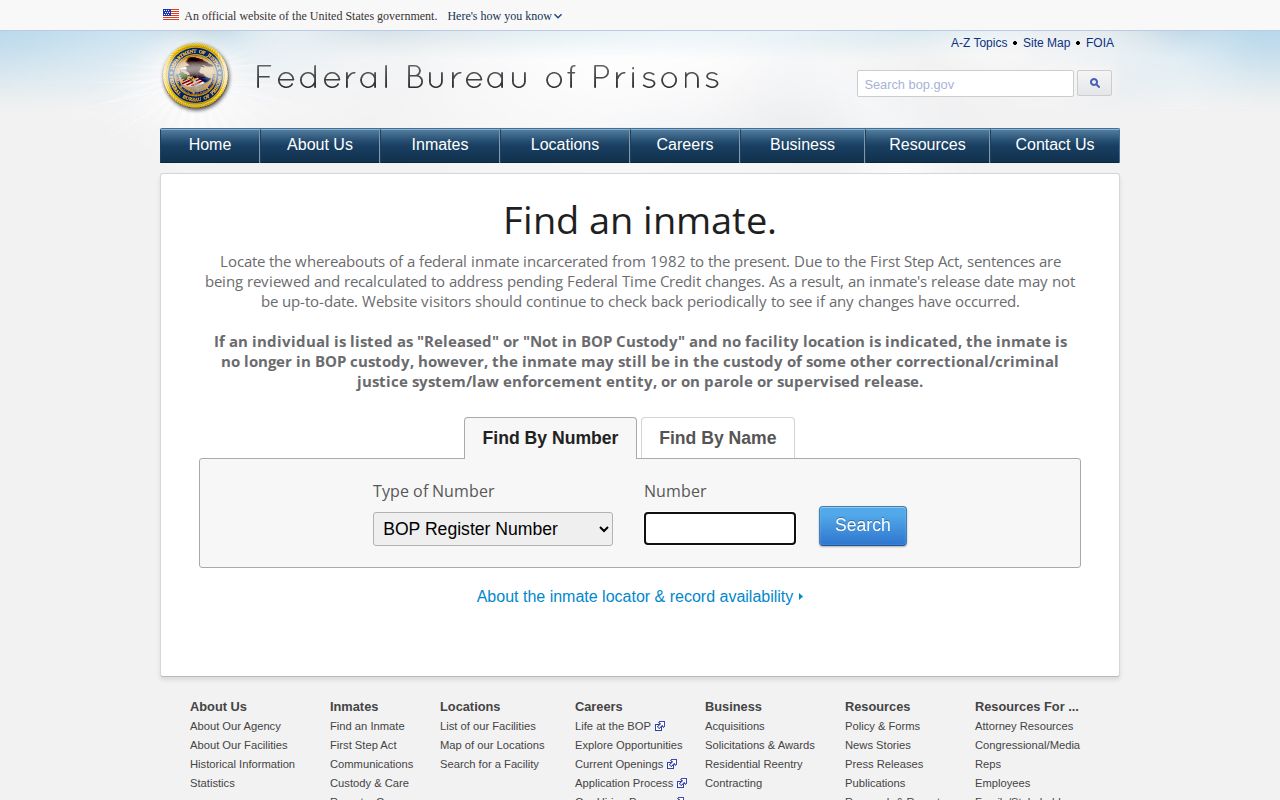
BOP's public records primarily reach federal inmates released after 1982. Older federal custody may require the National Archives rather than the current locator.
Confirm a Federal Release
A BOP result is strong evidence for the stated federal custody event, but it should be paired with the legal record when the manner of release matters. The federal court docket may contain a judgment, amended judgment, release order, supervised-release terms, or other controlling entry. The Bureau's sentence computation and institutional records explain how the posted date was reached. A federal probation office may hold the supervision record after release.
Do not use an Essex General District or Circuit search as the sole source for a federal case. Federal proceedings use the United States district court system. Likewise, an MPRSC roster gap cannot establish a BOP release. MPRSC might have held a federal pretrial prisoner under a contract or transport arrangement, but the U.S. Marshals Service and federal court would control that stage.
BOP and USMS Differ
The U.S. Marshals Service commonly manages federal pretrial prisoners from arrest or remand through acquittal, court-ordered release, or commitment to BOP. It can use state, local, private, or federal beds. A person may therefore appear at a local jail without being a sentenced BOP inmate. Transport from that jail may also make the name disappear without any community release.
No public USMS historical release locator was verified. For a federal pretrial event, use the federal court release or detention order, the actual holding facility, and a focused USMS records request. Once the person is committed to BOP for a sentence, the BOP locator becomes the right public tool. The USMS custody record path covers the pretrial and transport stage.
- Remand
- A court order placing or returning a defendant to custody.
- Commitment
- Placement under the legal authority of the receiving correctional system.
- Supervised release
- Federal court supervision that may follow imprisonment.
- Detainer
- A hold or request from another authority that can affect the next destination.
BOP and ICE Differ
ICE detention is civil immigration custody. It is not part of BOP's sentenced prison network. A person released by BOP may be transferred to ICE if immigration authority applies. In that case, the BOP date proves departure from BOP but not community release. ICE's Online Detainee Locator System is the next public check, and the federal records should identify the receiving authority when disclosure permits.
An ICE result has different search fields and limits. It uses a nine-digit A-number with country of birth, or exact name with date of birth and country of origin. ICE can include some people released from its custody within the last 60 days, while BOP maintains its own federal inmate history. Neither database should be used as a substitute for the other.
Request BOP Release Records
The locator gives a compact public result. When more detail is needed, request existing BOP records that identify the person and event. Include the full name, register number, date range, and the specific release or sentence-computation item sought. A narrow request is more useful than asking the agency to create a complete life history. Privacy and law-enforcement limits can restrict what is released to someone other than the subject.
The BOP explanation of federal inmate records sets out the locator's coverage and the meaning of a past release date. Older pre-1982 records may be held by the National Archives. Federal court records may separately supply the judgment and supervised-release terms.
Federal Bureau of Prisons
Official record routes
BOP Inmate Locator for public status
BOP records process for custody documents
Federal court for release orders and judgments
National Archives for qualifying older records
Note: Use the register number in every request because it is the clearest link between a BOP result and its source records.
Essex Federal Custody Boundaries
Essex County geography does not decide federal custody. A local arrest may remain with MPRSC and Virginia courts. A state conviction may lead to VADOC. A federal defendant may be held through USMS in a contract facility before release or BOP commitment. ICE may become the receiving civil custodian after a local, state, or federal release. The legal authority and receiving-agency fields decide which route applies.
The Essex County released inmates search helps separate these systems when the starting record is unclear. Use a current roster only to test current custody. For a past event, seek the release date, release type, and next custodian from the office that created the record.
BOP Date Verification
A federal release date should be read in context. For a future date, the locator provides a projection rather than a guarantee. Sentence recalculation, court action, credit changes, or First Step Act calculations can alter it. For a past date with no facility, BOP's published explanation supports departure from BOP custody, but the federal court and supervision record may still show obligations after imprisonment.
Use the register number to join the records. Names can change or match other people, while the federal identifier stays tied to the BOP entry. Save the exact location and release date labels. When a correction appears later, retain both captures and ask BOP for the underlying sentence-computation or release record rather than choosing the more convenient date.
Federal supervised release is imposed by the court and normally follows imprisonment under stated terms. It is not the same as Virginia parole or District 33 probation. A BOP result does not list every court condition. Review the judgment and docket for those details, and use the appropriate federal supervision office for current reporting information.
Older Federal Release Records
BOP's public locator primarily covers federal inmates released after 1982. A missing older person may require a National Archives request. Provide the full name, known federal number, court, sentence date, and facility if known. The absence of an older record from the locator reflects its stated coverage and should not be described as proof that federal custody never occurred.
Records may also be split by agency. The court holds the judgment, USMS holds pretrial and transport material, BOP holds sentenced-custody records, and the National Archives may hold qualifying older files. Identify the period first, then direct the request to the creator.
Preserve BOP Release Proof
Keep the search result, court order, and agency response together so the federal release date retains its proper custody context.