
Essex Projected and Actual Release
A projected, scheduled, or calculated date describes when a sentence is expected to reach a release point under the facts then in the record. It can move. An actual release date records that the custodian completed the event. The label shown by the source matters, so copy it exactly rather than replacing it with a stronger term. Research did not verify that every live VADOC result uses the word “projected.”
A pretrial detainee is different. No sentence has been imposed, so there is no earned-time calculation leading to a fixed exit. Bond, recognizance, dismissal, acquittal, a plea, a detainer, or a later court order can determine what happens. Even when a judge authorizes bond, MPRSC processing and other holds can affect the physical release. Court action is not the same as the door time.
A sentenced inmate has a computable term, but the responsible calculator varies. Local authorities handle many short jail terms. VADOC computes qualifying state-responsible sentence combinations. The source should match the legal custodian, not merely the building where the person is held.
Find an Essex Release Date
Begin with the sentence and custody system. Essex local detainees are commonly held at Middle Peninsula Regional Security Center. Its online list is current-only and shows Admit Date, but no release date, release reason, historical archive, or released-person filter. For a local calculation, use the sentencing order and ask MPRSC for the recorded or calculated information it holds. For a state sentence, begin with VADOC.
- Identify whether the person is pretrial, serving a local jail term, or serving a state-responsible sentence.
- Read the Essex court order for the sentence, suspended time, concurrent or consecutive terms, and credit addressed by the court.
- For MPRSC custody, call 804-758-2338 or request the existing release or discharge sheet and recorded date.
- For VADOC coverage, search by the first three letters of the first name plus full last name, or use the seven-digit DOC ID.
- Copy any displayed status, location, and date field with its exact label and note that the locator updates daily.
- After the expected date, confirm the actual event through the custodian's release document or a matched VINE event.
The VADOC Inmate and Supervisee Locator covers VADOC institutions, community-supervised probationers and parolees, institutional hospitals, CCAP, and certain people in local or regional jails under VADOC authority. It is not a full list of every Essex arrest or short local sentence. Absence does not prove discharge.
For a named person whose custody path is uncertain, the Essex County released inmates search explains how to combine the roster, court, VINE, VADOC, and records-request channels.
Virginia Release Credit Regimes
Virginia does not use one good-time percentage for every sentence. First identify the controlling regime and offense date. Good Conduct Allowance generally concerns pre-1995 felonies and older misdemeanors described by VADOC. Virginia Code § 53.1-201 sets class-based allowance rules for covered cases. Modern covered felony sentences use Earned Sentence Credits under §§ 53.1-202.2 through 53.1-202.4.
Under § 53.1-202.3, listed offenses may be capped at 4.5 days of credit for each 30 days served. Other eligible offenses can fall into Level I at 15 days, Level II at 7.5 days, Level III at 3.5 days, or Level IV at zero days per 30 days served. Eligibility, offense exclusions, behavior, and program rules control the tier. A headline percentage cannot replace the actual statute and computation.
The familiar truth-in-sentencing shorthand says a person serves at least about 85 percent. Yet 4.5 credits per 30 days yields roughly 86.96 percent when no other factor changes the math. Newer eligible credit tiers can differ more. Saying “85 percent for everyone” is wrong. The exact offense, governing version of law, sentence record, and current VADOC calculation must be checked.
The official VADOC Time Computation page presents the earned-time categories and warns that date information may change.
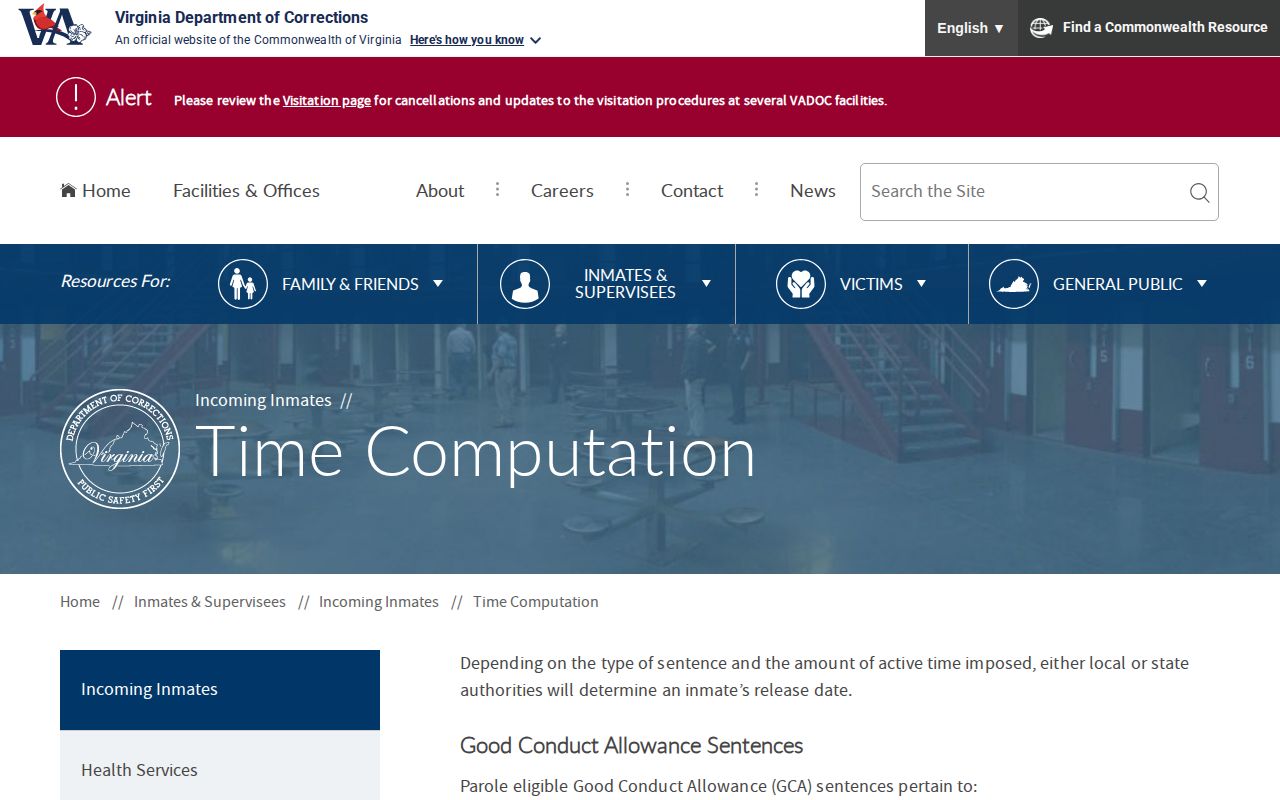
The captured categories apply to qualifying state-responsible sentences, not automatically to a short term calculated by MPRSC.
Essex Local Sentence Calculations
MPRSC and local authorities handle many short jail terms. Start with the signed sentencing order. Identify active time, suspended time, credit for presentence confinement, and whether terms run at the same time or one after another. A court record can show the legal sentence and disposition. The custodian then applies the order and records the actual release event.
Do not transplant VADOC's state-prison earned-credit table onto every MPRSC sentence. Local calculations may involve different legal rules and facts. A probation violation, corrected order, additional case, or jail credit can change the result. Electronic incarceration and work release may allow time in the community while custody obligations continue, so physical presence outside the jail is not always final discharge.
MPRSC does not publish a release-date tool. Its current list shows admitted people only. A dropped name cannot reveal whether the person completed a term, posted bond, transferred, entered a community-custody program, or was removed after a data correction. Ask for an existing release sheet when the actual date or disposition matters.
Note: A court sentence explains legal authority, while the jail record confirms the date and manner in which MPRSC processed the exit.
Weekend Service Is Not Final Release
Essex County has a distinctive local timing trap. Under Virginia Code § 53.1-131.1, a court may allow a qualifying active term of 45 days or less to be served on nonconsecutive days. MPRSC's published weekend policy says the normal report time is 6:00 p.m. Friday. The person may leave after the weekend interval and still owe more active sentence time.
A Sunday departure therefore is not necessarily sentence completion. It may be the scheduled break between custody intervals. Check the court's authorization, the remaining active term, the MPRSC weekend schedule, and the final completion record. The same caution applies to a current roster: someone outside the facility on Monday may still have an ongoing sentence obligation.
| Observation | What it may mean | Best confirmation |
|---|---|---|
| Friday report | Start of a scheduled intermittent interval | Court order and MPRSC weekend record |
| Sunday departure | End of one interval, not always the whole term | Remaining active-time calculation |
| Name absent between weekends | Person may be in an authorized community interval | MPRSC confirmation |
| Last required weekend completed | Possible sentence completion | Final jail release or discharge entry |
The MPRSC weekend inmate information is the local policy source. It should be read with the current court order because a general policy cannot establish one person's final date.
Why Essex Release Dates Change
A computed date reflects the sentence information and credits available at that moment. Later records can alter it. Some changes shorten the calculation; others extend custody or change the destination without changing the sentence end. A detainer is a request or legal basis for another authority to take or hold the person. It can turn an expected community exit into a transfer.
| Factor | Effect on the date or event |
|---|---|
| Presentence jail credit | Changes the amount of time still owed when properly applied. |
| Concurrent or consecutive orders | Changes whether sentences overlap or run one after another. |
| Earned-credit level | Changes the rate at which a qualifying VADOC sentence advances. |
| Disciplinary change | May alter credit status under the governing rules. |
| Corrected court order or revocation | Can change active time and require recomputation. |
| Detainer or hold | May change the receiving custodian, so the person does not enter the community. |
| Parole decision | A grant may authorize conditional release for an eligible sentence, but does not prove the physical exit date. |
Statutory amendments can also require a new calculation. Versions and effective dates matter. VADOC or the local custodian should apply the controlling law, while the public reader should avoid doing sentence arithmetic from a docket summary alone.
VADOC Essex Release-Day Records
For a VADOC release on discharge or parole, state guidance says the person is to be released by 11:59 p.m. on the release date, weather permitting. That rule belongs to VADOC facilities. MPRSC publishes no equivalent fixed release-hour promise, so the state deadline must not be copied onto a local Essex jail release.
VADOC identifies documents such as an Order of Release, Conditions of Probation, or Conditions of Parole, signed and witnessed. A release-notification letter, time-computation record, and inmate master record may provide additional evidence. State procedures can also cover personal property, offender-pay funds, transportation, medication, and detainers. A detainer changes where the person goes.
The official VADOC Facility Release page displays the state procedures and release documents.
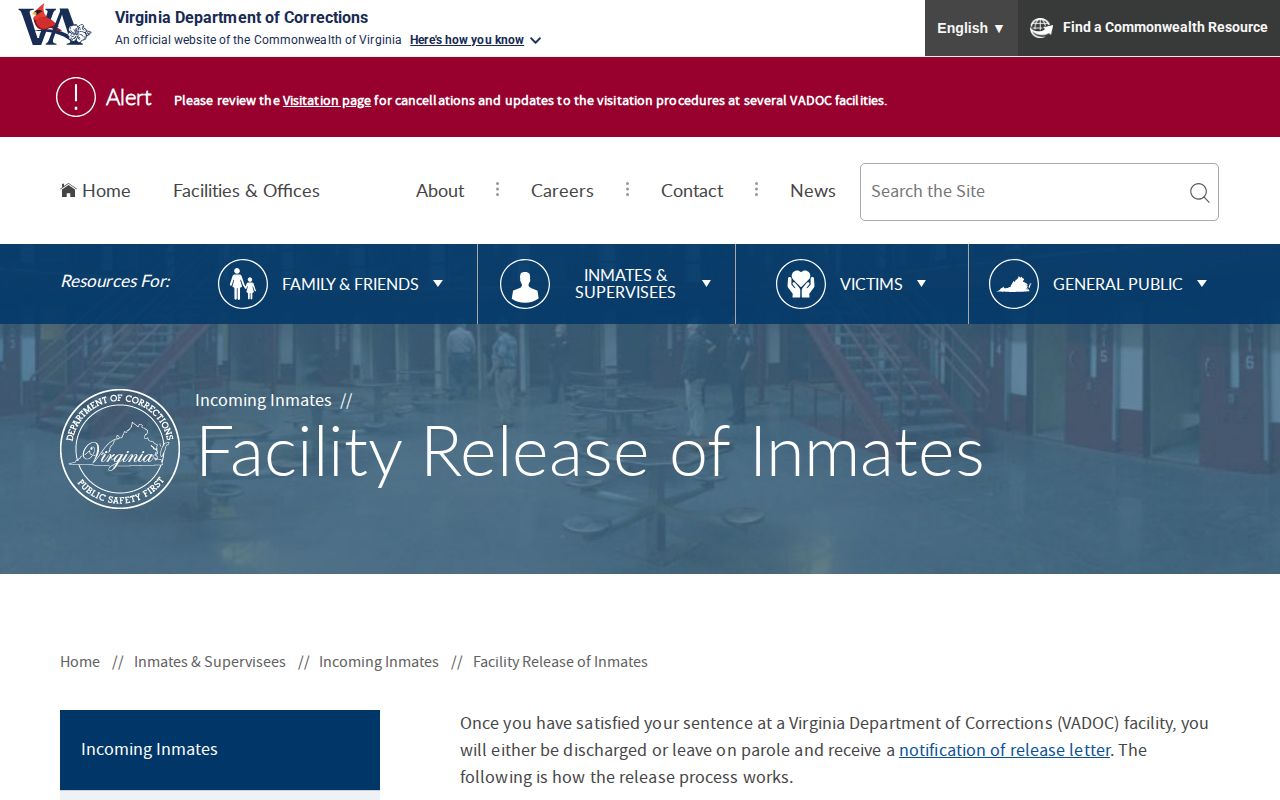
The state release source confirms a VADOC process, not the exit time or property practice at MPRSC.
Confirm the Essex Actual Release
After the expected date, check the same custodian again. For MPRSC, compare the current roster, call the jail, review the court disposition, and request the release sheet. For VADOC, check the locator and the signed release document. A supervision assignment at District 33 may confirm that community supervision began, but it still does not supply the exact prison-door time.
A pending alert through the Essex County VINELink release check can report a custody event. Jail VINE and VADOC VINE are separate workflows. A jail “release” alert may be a transfer to another jail or VADOC, so call MPRSC to learn where custody went. Notifications end after release and are not a permanent release archive.
Use precise language when sources differ. “The locator displayed a date,” “MPRSC no longer listed the name,” “VINE reported a custody event,” and “the release sheet recorded discharge” are not interchangeable. The final statement should identify what ended and what continued, including another custodian, parole, probation, or other court-ordered status.
A focused records request can close the gap when the public tools stop short. For MPRSC, identify the person by full name and an approximate booking period, then ask for the existing release or discharge sheet, the recorded date and time, the recorded reason or disposition code, and any nonexempt field naming a receiving custodian. Requesting existing fields avoids asking the jail to build a new timeline. Virginia FOIA allows a response that provides the record, withholds it under a cited basis, provides a redacted part, identifies that it cannot be found, or invokes the permitted extension.
For a VADOC sentence, a narrow request can seek the applicable release document or time-computation record. VADOC files may contain protected inmate, medical, investigation, or supervision material, and personal access may require consent or an agency form. A public locator value is therefore useful but not always the final record. When the date matters, preserve the exact online label, then seek the signed document that records the completed event.